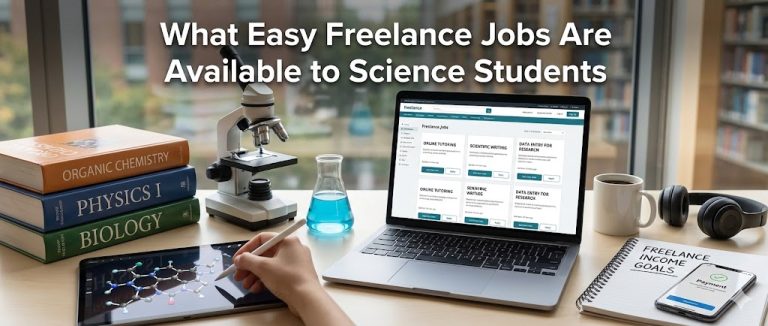
Science students usually explore for methods to make money while maintaining their academic concentration. Regular practice and analytical abilities are necessary for science courses. Students may earn money in a relaxed setting without expending time on travel by taking on freelancing jobs from home. But due to the pressure from their studies, students frequently inquire about online class help services. While numerous services are available online, you can always hire experts at MyAssignmentHelp when you need to pay someone to do your online course especially if your responsibilities become overwhelming.
Science students who require focus and frequent revision can benefit from home-based freelancing employment because it is safe and less mentally exhausting.
Why Science Students Should Take Home-Based Freelance Jobs
It is helpful to establish an ideal equilibrium amongst pursuing a side job and paying attention to your education. Also, doing work from residence as a freelancer promotes responsibility and effective utilization of time. Probably the key benefits are:
- Adaptable timetables to accommodate study plans
- Lower strain on the body and mind
- Improved management of workload
- Possibility of developing career-ready abilities
Because of these benefits, science learners would be better off choosing freelancing work over traditional part-time employment.
Writing Science-Related Content Online
One of the simplest freelancing careers for students studying science to begin from home is content writing. It includes producing articles and blogs or sometimes you need to write brief explanations of basic subjects.
Basic English language learners can gradually advance while making money. Additionally, writing enhances comprehension and memory, both of which are beneficial in science courses.
Students studying science can write:
- Basic instructional blogs
- Study guide for novices
- Science lectures for students in schools
The job enables individuals remain concentrated on their study because it does not need long hours of work and enhances interpersonal ability.
Homework assistance and online tutoring
For science students who are skilled at communicating, distance learning may be highly advantageous. Educating younger students increases their self-assurance and solidifies their topic understanding. It is beneficial for studying because teachers can select specific times and subjects.
Fear and pressure often lead students to think phrases like, I wish someone could take my chemistry class for me, especially when they look for online help with difficult courses. Instead, science students can earn money the right way by gaining a thorough understanding of chemistry concepts through tutoring.
Typical options for tutoring:
- Introductory science and math tutoring
- Confidence-building exercises
- Advice on science related homework
Data Entry and Basic Virtual Assistance Jobs
For biology graduates looking for comfortable work, data entry positions are ideal. Typing, organizing data, and record updating are typically included in these jobs. They conserve students’ mental resources for their studies because they do not call for innovative thinking.
Tasks for virtual assistants could include:
- Handling emails
- Task planning
- Worksheet updates
For students who enjoy regular work without interruptions, these occupations are easy and ideal.
Using Simple Tools for Graphic Design
Learners that are creatively inclined might experiment with graphic design using basic instruments. Presentations, social media posts, and plain banners are in high supply. Sophisticated expertise in software is not initially required for this position.
Among the advantages for scientific students are:
- A creative diversion from technical subjects
- Ability beneficial for future employment
- Work that is project-based and has deadlines
Planning enhances concentration and ability to solve problems, which promote scientific reasoning.
Jobs for Transcription and Captioning
Transcription is the process of turning sounds into text. For students who prefer to work in silence, this employment is peaceful and concentrated. Composing short headlines for articles or videos is comparable to subtitle writing.
Why this is effective:
- Enhances creativity and listening abilities
- Advanced expertise is not necessary.
- Adaptable income from tasks
Quick study breaks are ideal for this task without impairing focus.
Beginners’ Guide to Online Research Support
Those studying science receive training in information gathering, analysis, and organization. A lot of independent contractors are employed to gather information, summarise articles, or provide basic reports. These assignments align with scientific learning approaches.
Research assignments consist of:
- Obtaining data from reliable sources
- Making succinct summaries
- Appropriately structuring data
This kind of labor strengthens one’s academic standing and prepares one for further education or employment.
Handling Social Media for Small Websites
Another easy freelancing job is running social networking pages. Learners plan postings, respond to responses, and monitor interaction. This position provides technological abilities without requiring a lot of work.
People studying science gain from:
- Work is not dependent on hours, but rather on time.
- You can complete tasks after studying.
- In today’s workforce, abilities are valuable.
Individuals that appreciate communication and use technology will benefit most from it.
Micro tasking and Online Surveys
Websites for surveys and microtasks provide brief, paid assignments. For novices who desire light labor without pressure, these assignments are perfect. These employments are versatile and relaxing despite the low pay.
Examples consist of:
- Responding to surveys
- Examining the content
- Testing simple applications
How Science Students Can Manage Their Studies and Freelancing
It is crucial to balance employment and school. Education should always be the first concern for students. Establishing a daily schedule facilitates efficient management of both.
Useful guidance:
- Avoid working beyond a few hours a day.
- Plan your study time to coincide with your peak concentration time
- Steer clear of employment with tight deadlines when taking tests.
Effective planning guarantees that freelancing promotes development rather than undermining education.
The Benefits of Freelancing for Science Students
Making money is not the only aspect of freelancing. It supports students’ intellectual and individual development. These abilities enhance long-term achievement.
Important abilities consist of:
- Effective utilization of time
- Interaction with different kinds of people
- Self-control
- Knowledge of digital media
With these abilities, youth feel confident and prepared to take on new challenges.
Choosing Secure Freelance Websites
Being secure is especially important for kids. Remain clear of deceptive offers and always select reliable websites. Whether they are personal or work-related, students ought not to disclose their login information or passwords.
Safety advice:
- Examine platforms thoroughly.
- Steer clear of solicitations for advance payment.
- Make use of safe ways of paying
Freelancing ethically is always preferable to taking quick routes that compromise education.
Summarization
Science students have a clever approach to make money without losing focus by working easy freelance jobs from home. There are numerous solutions that suit academic schedules. Students can develop their talents and maintain their academic strength by selecting flexible jobs.
Smart freelancing fosters comfort and balance rather than taking quick routes or taking chances. This strategy guarantees academic and personal growth success without depending on any kind of online help alternatives.
FAQs
- Can science students safely work as freelancers?
Freelance work is secure for learners as long as they use trustworthy sources and do not reveal private data. The risks of travel stress are reduced when one works from home.
- What is the recommended daily workday?
Students ought to limit their time as freelancers for a few hours per day. This lets you to continue concentrating on your schoolwork while earning a little extra income.
- Does being a freelancer affect your academic performance?
Freelance work does not negatively impact academic achievement when chosen carefully. In fact, flexible and stress-free work can enhance time control and discipline.