
Key Takeaways
- Lord Dunmore’s proclamation of November 7, 1775, offered freedom only to enslaved people belonging to rebels who were able and willing to bear arms, which excluded the elderly, most women, children, and anyone owned by a Loyalist.
- Roughly 20,000 enslaved people reached British lines over the course of the war, making this one of the largest emancipations in North America before the Civil War and one of the least discussed.
- Thousands of Black Patriots also served the American side, including the 88 enslaved men who enlisted in the First Rhode Island Regiment under that state’s February 1778 act, which means this is not a story of one side offering freedom and the other refusing.
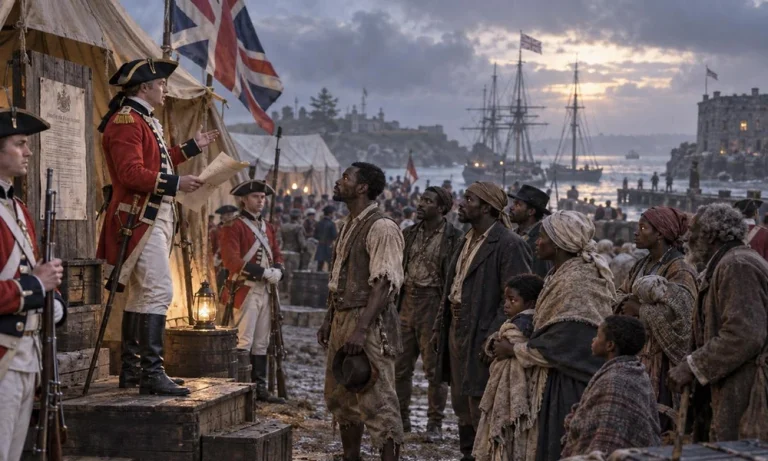
- General Guy Carleton defied the Treaty of Paris in 1783 by evacuating roughly 3,000 Black Loyalists from New York rather than returning them as property, recorded in the ledger known as the Book of Negroes.
- Freedom in Nova Scotia proved thin: land grants were delayed until 1787 and undersized, the 1784 Shelburne riots targeted Black settlers, and by 1792 about 1,200 left for Sierra Leone.
The Story We Usually Tell, and What It Leaves Out
The standard telling of the American Revolution notes, usually in a paragraph, that the language of liberty sat awkwardly beside the fact that about a fifth of the population was enslaved. The paragraph typically ends there, treated as an irony to acknowledge rather than a subject to investigate.
What that treatment misses is that enslaved people were not passive observers of this contradiction. They analyzed it, and in tens of thousands of cases they acted on it, often at enormous risk. The Black Loyalists who crossed to British lines were making a strategic judgment about which side offered the better odds.
They were also not deceived about what they were being offered. Britain’s proclamations were military instruments designed to destabilize rebel property, and their terms said so plainly. This piece examines what was actually promised, who took the offer, what happened to them, and why a meaningful number of Black Americans made the opposite choice.
What Dunmore Actually Promised
The short answer: On November 7, 1775, Virginia’s royal governor declared free all indentured servants and enslaved people belonging to rebels who were able and willing to bear arms for the Crown. The conditions were restrictive by design. It was not a general emancipation and was never presented as one.
Read the qualifiers. Freedom applied only to those “appertaining to Rebels,” so enslaved people held by Loyalists remained enslaved. It applied to those able to bear arms, which in practice meant men of fighting age.
Dunmore’s purpose was military. Virginia’s planter elite led the rebellion, and threatening the labor force that underwrote their wealth was a way to make rebellion expensive. Whether it worked is debatable: Mount Vernon’s account notes it hardened white Virginian opinion against the Crown as much as it weakened the rebellion.
The Ethiopian Regiment formed from those who reached him grew to nearly 800 men. Quartered on ships near Norfolk and later at Gwynn’s Island, poorly supplied and exposed to disease, the unit was devastated before it could accomplish much militarily.
EVIDENCE CHECK: Dunmore’s Proclamation is sometimes described in popular accounts as Britain freeing the slaves. The document’s own text contradicts this. It covered only the enslaved people of rebels, only those able and willing to fight, and left slavery in the British Empire entirely intact. Britain did not abolish the slave trade until 1807 or slavery in most of its colonies until the 1830s.
How the Offer Widened, and What It Still Withheld
The short answer: Sir Henry Clinton’s Philipsburg Proclamation of 1779 extended the offer across all thirteen colonies and dropped the requirement of military service. It was a significant broadening. It also offered no guarantee of protection, and Black people captured by British or Loyalist forces were frequently re-enslaved anyway.
The practical effect was substantial. Estimates put the number of those who reached British lines over the war at roughly 20,000, a mass movement organized largely by the people undertaking it through networks and information that left almost no documentary trace.
Conditions in the British camps were often brutal. Overcrowding and inadequate supply made them incubators for smallpox during the continental epidemic of 1775 to 1782, and many who escaped slavery died within months of reaching what they had been told was freedom.
Twenty thousand people crossed enemy lines on the strength of a document that promised them very little.
Britain’s interest remained instrumental throughout. Black refugees were used as laborers, pilots, foragers, and auxiliaries, and their status depended on the discretion of individual commanders rather than any settled imperial policy.
The Choice That Complicates the Story
The short answer: Thousands of Black Americans fought for the American side, not the British. Rhode Island’s February 1778 act declared that enslaved men who enlisted would be absolutely free, and 88 enslaved men took that offer. Of roughly 225 men the regiment recruited, probably fewer than 140 were Black or Native.
This is the fact that prevents the episode from resolving into a simple moral scoreboard. If Britain had been offering genuine liberation and America had been offering nothing, the choice would have been obvious, and it was not.
Historian Alan Gilbert’s Black Patriots and Loyalists: Fighting for Emancipation in the War for Independence argues that the promise of freedom drew Black enlistment into both the Continental Army and the British forces and that the numbers on each side have been consistently underestimated. Read that way, Black Americans were pursuing a single objective through two available channels.
The calculation was local and practical. It depended on which army was nearby, whether a state offered manumission for service, how a particular owner was aligned, and what a person’s family situation allowed.
That is a more demanding story than either patriotic or revisionist shorthand allows, and it credits the people involved with the judgment they actually exercised.
The Evacuation and the Ledger
The short answer: The Treaty of Paris in 1783 required Britain to return confiscated property, which American negotiators understood to include enslaved people. General Sir Guy Carleton refused, arguing that those freed under British proclamations could not be returned, and evacuated roughly 3,000 from New York.
The mechanism was a register, compiled under Brigadier General Samuel Birch, that came to be called the Book of Negroes. It recorded names, ages, physical descriptions, former owners, and the circumstances of each person’s escape.
The ledger’s purpose was bureaucratic, intended to document British liability so that compensation claims could later be settled, and that compensation largely never materialized. Its effect was archival: it is one of the earliest substantial registers of named Black individuals in North American records, and it remains a primary genealogical source today.
Between April and November 1783, approximately 3,000 people departed New York in 81 ships. Washington raised the matter with Carleton directly and did not prevail.
What Freedom Looked Like in Nova Scotia
The short answer: Black Loyalists who reached Nova Scotia found legal freedom without material security. As The Canadian Encyclopedia documents, land grants promised on arrival were delayed until 1787 and came in smaller parcels than white Loyalists received, and Birchtown, the largest of the settlements, became one of the most populated free Black communities outside Africa.
The conditions that followed were severe: food and clothing shortages, hard winters, indenture arrangements that reproduced much of slavery’s coercion, exclusion from schooling, and open hostility from white settlers competing for the same scarce resources.
In 1784, white Loyalists in Shelburne attacked Black residents and destroyed property in what are generally counted among the earliest race riots in North America. The grievance was economic competition combined with resentment over land allocation.
By 1792, roughly 1,200 Black Loyalists left Nova Scotia for West Africa, founding Freetown in Sierra Leone. That migration is the clearest verdict available on how the British promise was fulfilled: a substantial share of those who had accepted it crossed an ocean again to get away from the result.
Twelve hundred people took Britain’s offer of freedom and then left the empire to find it.
Why It Still Matters
The Black Loyalists complicate both of the stories usually told about the Revolution. They undercut the version in which American independence and human liberty advanced together, and they equally undercut any version in which Britain appears as an antislavery power.
What remains is harder and more useful: a war in which enslaved people assessed two empires, found neither committed to their freedom, and extracted what they could from both. Roughly 20,000 acted on that assessment, which makes it one of the largest collective acts of self-liberation in early American history.
It also demonstrates something about historical sources. We know these people’s names largely because a British officer was keeping a compensation ledger, which is a reminder that whose lives get recorded depends on who found it administratively useful to write them down.
Frequently Asked Questions
What did Dunmore’s Proclamation actually say? Issued November 7, 1775, and made public on November 15, it declared free all indentured servants and enslaved people belonging to rebels who were able and willing to bear arms for the Crown. It excluded people held by Loyalists and, in practice, most women, children, and the elderly.
How many enslaved people escaped to British lines during the Revolution? Estimates put the figure at roughly 20,000 over the course of the war, with more than 5,000 eventually becoming refugees elsewhere in the British Empire. Precise numbers are impossible because most escapes went unrecorded and mortality in British camps was very high.
What was the Book of Negroes? A register compiled under Brigadier General Samuel Birch in 1783 recording roughly 3,000 Black Loyalists evacuated from New York, including names, ages, descriptions, and former owners. It was created to document British liability for compensation claims and is now a significant genealogical and historical source.
Did Black Americans fight for the Patriot side too? Yes, in substantial numbers. Rhode Island’s February 1778 act declared that enslaved men who enlisted would be absolutely free, and 88 did so in the First Rhode Island Regiment. Historian Alan Gilbert argues that Black service on both sides has been consistently undercounted.
Why did Black Loyalists leave Nova Scotia for Sierra Leone? Promised land grants were delayed until 1787 and were smaller than those given to white Loyalists. Settlers faced food shortages, exploitative indenture, exclusion from schooling, and violence, including the 1784 Shelburne riots. About 1,200 emigrated in 1792 to found Freetown.
Further Listening & Reading
Hear historians discuss these questions directly in the AAR interview series and History Behind News episodes. For related perspectives, see how the war looked from London in Rethinking King George III, explore The British Perspective, or browse the full Themes of the American Revolution collection.