
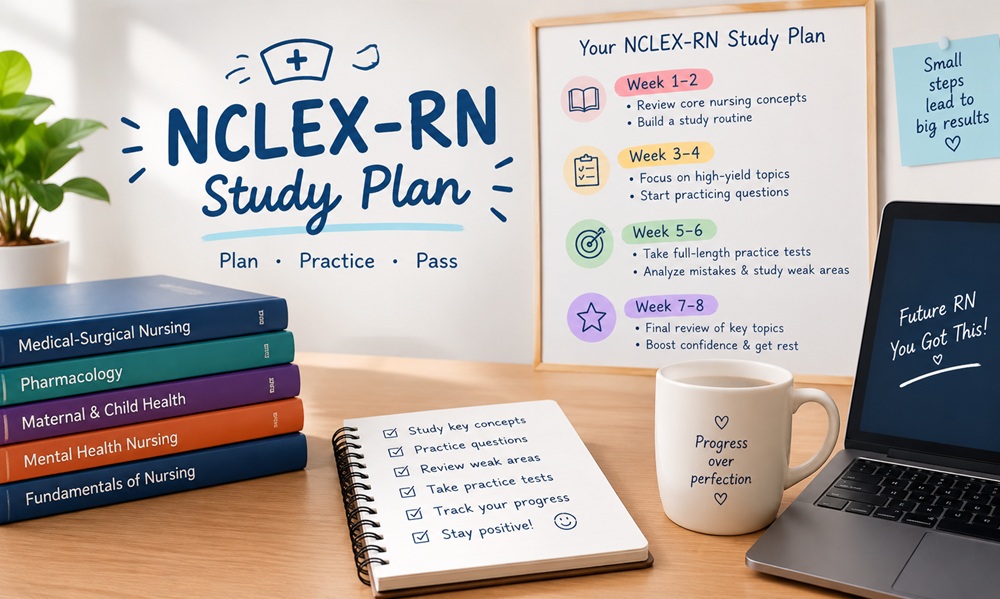
A useful NCLEX-RN study plan should tell you what to do when you sit down, how to review what you missed, and when to change direction. A calendar that says “study nursing for two hours” leaves all three decisions unanswered.
For graduates balancing work, family responsibilities, and an approaching exam date, the solution is a repeatable study session with a clear stopping point. Begin with the current exam plan, use questions to identify specific gaps, and reserve enough time to understand the reasoning behind each answer.
The schedule below is an adaptable example. It is not an official NCSBN program or a promise that a particular number of weeks will be enough for every candidate.
Start with the test plan that applies to your appointment
NCSBN’s 2026 NCLEX-RN test plan applies from April 1, 2026, through March 31, 2029. Use it to check the content categories and clinical judgment expectations your materials should address.
Make a short inventory of your resources. You need an outline of the tested content, explanations you can consult when you find a gap, practice questions, and exposure to the official item formats. Buying several overlapping question banks before using one carefully can make it harder to see what you actually need.
Keep NCLEX preparation separate from continuing education for license renewal. This plan concerns preparation for the licensure examination; completing it does not award CE credit or establish eligibility to test. Check eligibility with the nursing regulatory body where you are applying.
Build a starting point you can use
Begin with a small mixed set, such as 15 to 20 unfamiliar questions. Work without notes and record which answers felt uncertain. A correct guess belongs on your review list alongside an incorrect answer.
For accessible topic review, Every Exam Prep’s free NCLEX-RN practice questions include answers and explanations without requiring signup. Use them to identify concepts worth revisiting, alongside the official preparation resources.
After the set, classify each difficulty:
- Knowledge gap: You could not explain the concept being tested.
- Missed information: You overlooked a detail in the scenario.
- Reasoning gap: You recognized the facts but struggled to choose between actions.
- Uncertain success: You answered correctly without being able to justify your choice.
These categories lead to different next steps. A knowledge gap calls for targeted reading. An overlooked detail calls for closer question review. A reasoning gap calls for comparing the possible answers and identifying what makes one fit the stated situation.
Use a 45-minute session with a defined output
Try the following structure when your available study time is limited:
| Time | Task | What to produce |
|---|---|---|
| First 5 minutes | Recall yesterday’s difficult concept without notes | A short explanation in your own words |
| Next 15 minutes | Answer a manageable set of new questions | Answers plus confidence notes |
| Next 20 minutes | Review errors and uncertain answers | Two or three specific corrections |
| Final 5 minutes | Choose the next topic | A concrete task for the next session |
Reduce the question count if reviewing the explanations takes longer. Finishing a large set is less useful for planning if you cannot say what it revealed.
On a crowded day, keep the smallest meaningful version: explain one previous mistake and answer a few fresh questions on that concept. Avoid borrowing heavily from sleep simply to complete an arbitrary daily total.
Turn an answer explanation into a reasoning exercise
When reviewing a clinical scenario, write three sentences before moving on:
- “The detail that mattered most was…”
- “My answer was less appropriate because…”
- “If the scenario changed in this way, I would need to reconsider…”
For example, imagine you chose an option because it sounded generally helpful but missed that the question asked for the first action. Your correction should identify the task you misread. Writing “review priorities” is too broad to guide tomorrow’s work.
Keep this exercise tied to the explanation and your nursing references. Do not turn a single practice item into an absolute rule such as “always choose assessment” or “never choose an intervention.” Record the circumstances that made the answer appropriate.
If several questions expose the same weak topic, pause the question bank. Review that topic in a textbook, class materials, or a structured NCLEX-RN study guide, then return to new questions. Repeatedly missing the same concept is a reason to change the activity.
Spread the work across a realistic week
A week might contain four short question-and-review sessions, one longer session for unfamiliar item formats, and one session devoted to the topics your notes identify as weakest. Leave a catch-up window rather than filling every available hour in advance.
For someone working rotating shifts, anchor sessions to events rather than clock times: after breakfast on a day off, before an afternoon shift, or during a protected study block at the library. Choose the arrangement you can repeat without constant negotiation.
At the end of the week, review the evidence:
- Which concepts can you now explain without looking them up?
- Which mistakes appeared more than once?
- Did improvement carry over to unfamiliar questions?
- Which part of your schedule repeatedly proved unrealistic?
Use those answers to plan the next week. If you continually skip a long evening block, replace it with shorter sessions at a time you can protect.
Practice the official formats as well as the content
A general question bank should not be your only exposure to how the examination works. NCSBN provides an official sample pack, exam preview, and candidate tutorial. Use those resources to become familiar with item presentation and the testing software.
Do not assume that a third-party quiz recreates the NCLEX’s adaptive testing or scoring. Its percentage correct can help you track that particular practice activity, but it is not an official prediction of your result.
Keep a separate list of interface questions, such as how responses are entered and what navigation is available. Resolve them with the official tutorial and candidate materials, rather than letting uncertainty about the software compete with content review.
Decide what tomorrow’s session needs to accomplish
Before closing your notes, write a specific assignment: “Review the explanation for the two questions where I missed a change in the scenario, then try five new items on that topic.”
That is a more useful starting point than “do more questions.” It connects your next study session to an observed need and gives you a way to judge whether the session helped. Over time, your plan should become increasingly specific to the concepts and decisions you still find difficult.

Comments are closed.